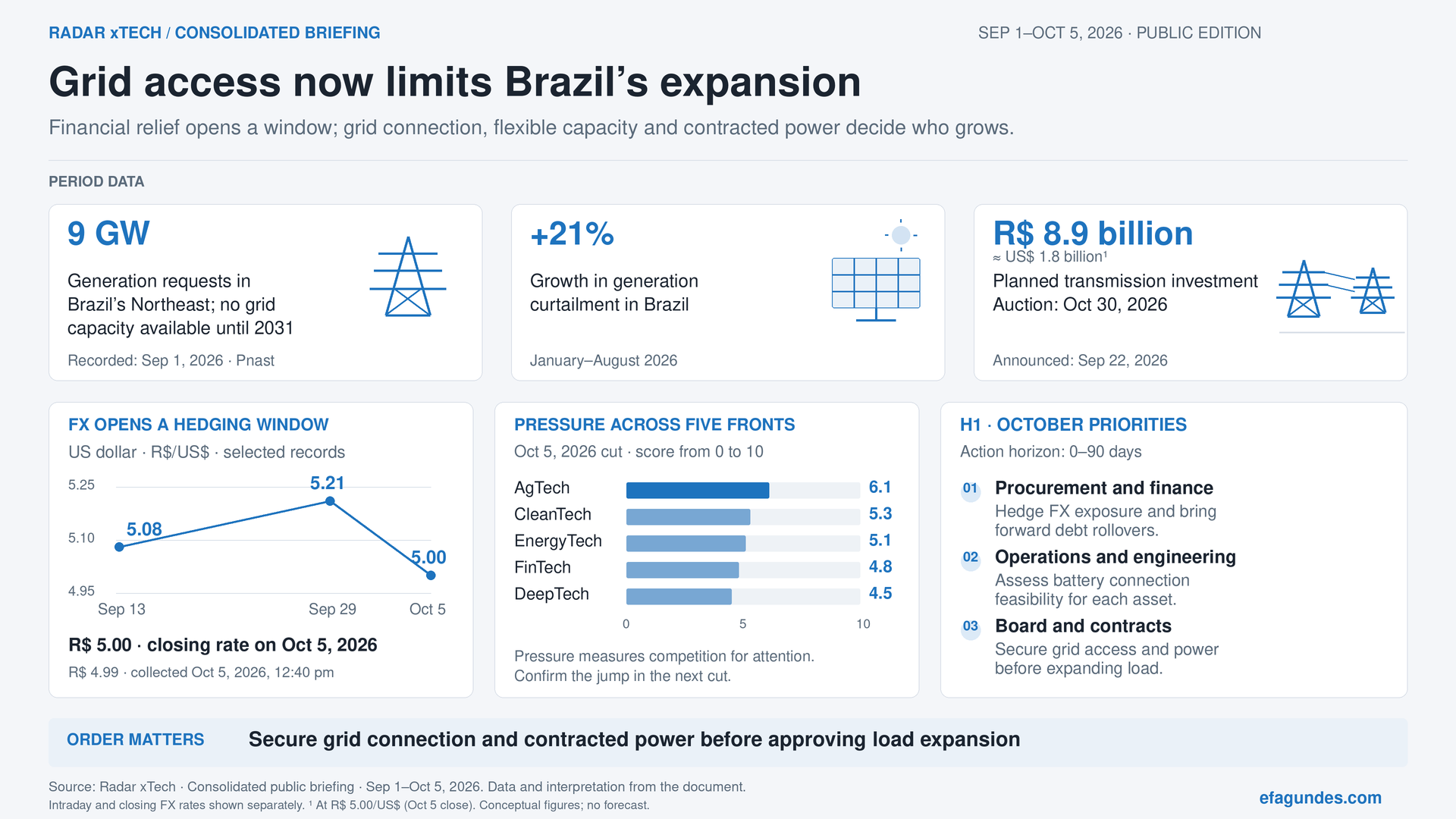
Between September 1 and October 5, 2026, the cost of capital fell in Brazil — the Selic went from 14.00% to 13.75% and the dollar closed October 5 at R$ 5.00 — but the constraint that sets the pace of data centers, electrification and renewables became the power grid. Radar xTech recorded 9 GW of generation requests in the Northeast with no transmission capacity until 2031 and an R$ 8.9 billion (≈ US$ 1.8 billion) transmission auction scheduled for October 30. October is a month to choose position in connection, contracted power and hedging, not to bring expansion forward.
Closing numbers (Oct 5, 2026)
| Indicator | Value | What it means |
|---|---|---|
| Selic (policy rate) | 13.75% p.a. | 0.25 p.p. cut in September; the Focus survey projects 13.50% at end-2026 |
| Real interest rate | 9.53% p.a. | Selic minus 12-month IPCA (4.22%): still prohibitive for long-payback projects |
| US dollar | R$ 5.00 | Oct 5 close (R$ 4.99 at the 12:40 pm collection, −4.9%): hedging window for imported equipment |
| Brent | US$ 102.49 | Up 6.5% in 30 days |
| Marginal operating cost SE/CW (ONS) | R$ 42.43/MWh | ≈ US$ 8.50/MWh; down 56.7% in the week, green tariff flag |
| Transmission auction | R$ 8.9 billion | ≈ US$ 1.8 billion; scheduled by ANEEL for Oct 30, 2026 |
| Generation without grid | 9 GW | Requests in the Northeast with no remaining capacity until 2031 (Pnast) |
Sources: Radar xTech base (BCB, ONS, ANEEL, IBGE, yfinance), cuts from Sep 13 to Oct 5, 2026. US$ equivalents at R$ 5.00 (Oct 5 close).
Why did the grid become Brazil’s scarce asset in September and early October 2026?
The period began, in September, with the diagnosis that Brazil lacks contracted flexible capacity for the load arriving on its grid, and ended with the regulator ANEEL confirming an R$ 8.9 billion transmission auction for October 30, 2026. In between, the central bank’s Copom cut the Selic by 0.25 points. Capital got a little cheaper; connection did not.
In the period’s first two cuts, Radar xTech classified six of eight strategic vectors as “mobilize now”. In the October 5 cut, no vector requires immediate mobilization and the six main ones call for capturing advantage: urgency shifted from reaction to positioning.
What changed in each xTech front?
EnergyTech · 60-day window
ANEEL, the grid operator ONS and the planning agency EPE issued a technical note on battery connection in the 2026 Capacity Reserve Auctions; ANEEL is assessing an R$ 804 million (≈ US$ 161 million) cut in Proinfa funding. Decision: set the position in the Oct 30 auction and commission a BESS connection opinion per asset.
DeepTech · 45 days
ReData data-center tax regime signed into law (Law 15,504/2026 and Complementary Law 237/2026), Anatel consultations on outdoor 6 GHz Wi-Fi until early December and changes of control at Desktop, Highline and Scala. Decision: review change-of-control clauses and make capex conditional on ReData qualification.
FinTech · 30 days
10-year US Treasury at 5%, IGP-M inflation of 1.57% in September and the Pix-TIPS link still without a schedule. Decision: map 12-month maturities and bring forward rollovers under two risk-premium scenarios.
CleanTech · 120 days
Mercosur-EFTA 67% clean-power clause in force with Iceland since Oct 1 and industry guidelines for Brazil’s carbon market. Decision: verifiable emissions inventory and climate projects financed with non-recourse debt.
AgTech · 45 days
Corn from 532 to 497.5 USc/bushel and over half of domestic phosphate production idle; biological inputs on 46 million hectares (+18%). Decision: one-harvest-payback solutions and an alternative phosphate supplier.
Which decisions should companies take in October?
Radar’s decision lens translates signals into decisions by function for a mid-sized company. The common point is order: connection and contracted power come before any load expansion.
| Function | October decision | First step |
|---|---|---|
| Procurement | Bring forward long-lead equipment purchases and lock in FX | Firm quotes from two suppliers, valid for 30 days |
| Operations | Assess storage connection at each asset | Identify the three points most exposed to curtailment |
| Sales | Use Brazil’s grid mix in proposals to EFTA clients | Review three open proposals with European clients |
| Legal | Review change-of-control and adjustment clauses | Check the three highest-value contracts |
| Finance | Map maturities and bring forward rollovers with hedges | Simulate a pre-approved line under two scenarios |
| Board | Connection and power before load expansion | Partners’ meeting within five days on the auction |
Frequently asked questions
What is Radar xTech?
Radar xTech is the strategic intelligence system of the efagundes.com think tank, based in Brazil. It monitors signals from more than 100 sources across five fronts — EnergyTech, CleanTech, DeepTech, FinTech and AgTech — and organizes them into three decision horizons: up to 90 days, 90 to 360 days and 1 to 5 years.
Why don’t falling interest rates unlock data-center expansion in Brazil?
Because the binding constraint is physical and regulatory. Even with the Selic at 13.75%, the real rate is 9.53% a year, and 9 GW of generation requests in Brazil’s Northeast have no grid capacity until 2031. Without contracted connection and firm power, cheaper capital does not become installed capacity.
When is ANEEL’s transmission auction and how large is it?
ANEEL confirmed the transmission auction for October 30, 2026, with R$ 8.9 billion (about US$ 1.8 billion) in planned investment. The decision to take part as bidder, consortium member or anchor load is due by mid-October.
What changed for battery storage (BESS) in Brazil in September and early October 2026?
Three regulatory steps: a public consultation on the battery Basic Production Process (PPB) — covering BESS, electric vehicles and distributed systems — proposing 61% domestic production by 2030; a draft rule passing BESS charges to consumers; and an ANEEL, ONS and EPE technical note on battery connection in the 2026 capacity reserve auction.
What period does the consolidated briefing cover?
The four or five weeks ending on the first Monday of each month. This edition covers September 1 to October 5, 2026. The window avoids attributing an early-month event to the previous month; market quotes carry their collection time.
Is the full edition available in English?
No. The public edition (Horizon 1) is available in English, Portuguese and Spanish. The complete subscriber edition, with Horizons 2 and 3, is published in Portuguese.
Download the public edition
23 pages with the period’s situation room, the pulse of the five fronts, quantitative constraints, what accelerated, October’s decisions by function, a “Brazil in context” page and a glossary.
Download the free PDFSubscriber edition (in Portuguese)
The complete edition has 36 pages and adds the strategic pressure map, the period’s twelve scenarios, convergence across fronts, the maturity of 21 technologies and decisions by horizon.
Subscribe to Radar xTechAbout the think tank
efagundes.com is a technology and energy think tank active since 1996, led by Eduardo Mayer Fagundes — electrical engineer, MSc in Computer Science from Universidade Presbiteriana Mackenzie, CEO of nMentors Engenharia and former CIO of AES Eletropaulo. Radar xTech readings are technical analysis offered as a basis for discussion; they are not investment advice or legal opinion.
The Radar method is published in the free e-book (in Portuguese) Antes do Sinal Vermelho.