

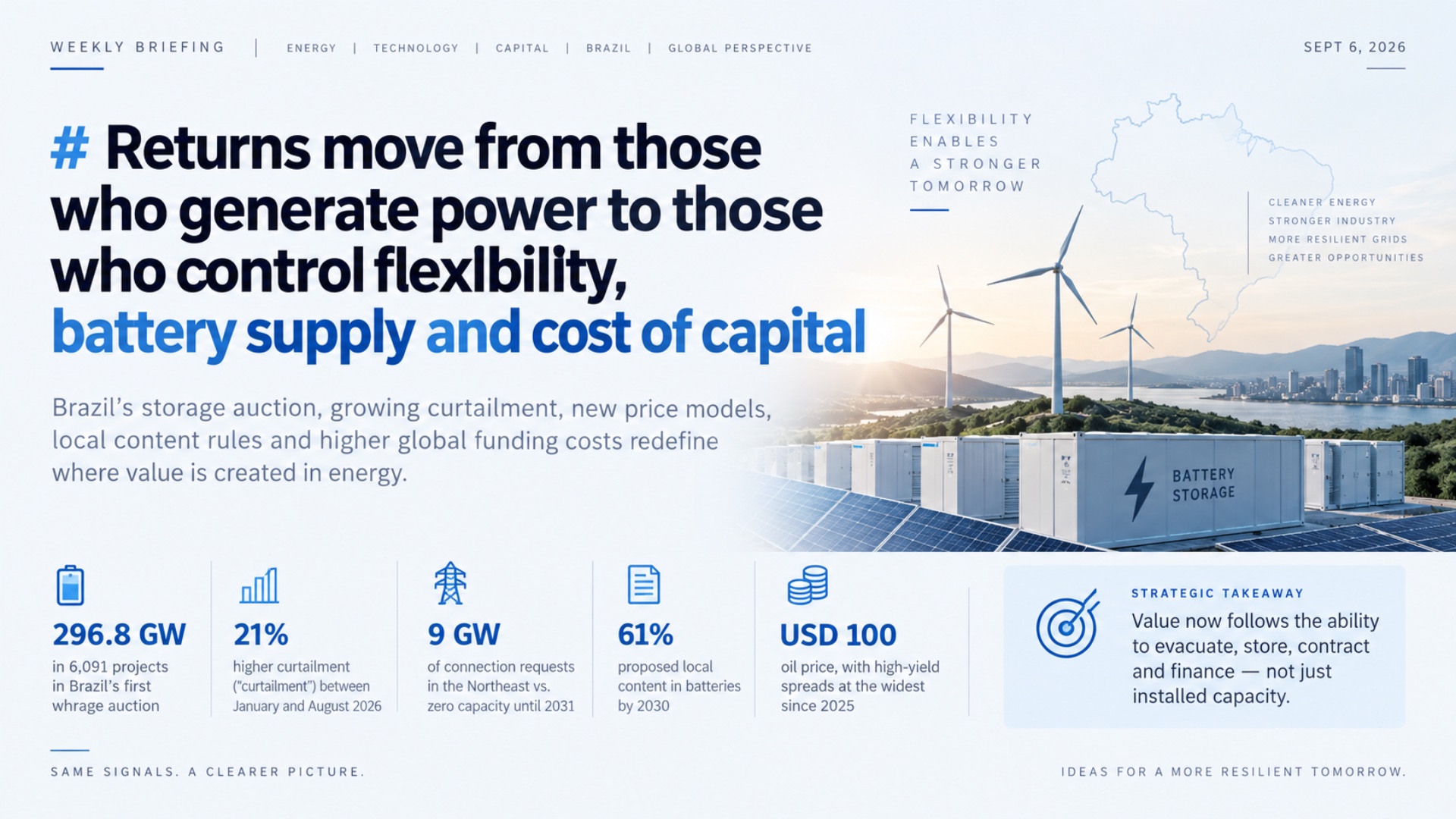
Abstract — Brazil’s first national storage auction drew 296.8 GW across 6,091 registered projects, turning battery storage from an innovation thesis into a capital allocation decision. Curtailment rose 21% between January and August 2026, the national grid operator recorded 9 GW of connection requests in the Northeast against zero remaining capacity until 2031, and on 2 September the market settlement body began applying new Future Cost Functions inside the official models that set the short-term power price. A public consultation on battery local content proposes requirements rising to 61% by 2030. Oil returned to USD 100 and high-yield spreads reached their widest since the 2025 currency crisis. The signals converge on one shift: returns no longer follow installed capacity, they follow control of flexibility, local industrial supply and access to funding.
Why this matters outside Brazil
Supply chain. A local-content requirement rising to 61% by 2030, landing on a market that has just revealed 296.8 GW of storage appetite, forces every global cell and integration business to make a Brazilian manufacturing decision now rather than when the threshold takes effect. A Chinese cell manufacturer has already positioned through a partnership to contest the auction. Whoever waits for the rule to bind will be negotiating from behind.
Capital. Brazil is running, at national scale and ahead of most markets, the experiment of what happens when renewable build-out outruns transmission. Curtailment up 21% in eight months, with zero remaining connection capacity in the country’s best resource region until 2031, is a live preview of a constraint that Chile, Spain, Australia, Texas and India are approaching on their own timelines. The Brazilian repricing of grid access is a leading indicator, not a local curiosity.
Regulatory precedent. Brazil has just conditioned a data-centre tax incentive on the facility being supplied by renewable or low-emission sources. That is one of the first national-scale linkages of fiscal treatment to power sourcing for computing load. Any jurisdiction now drafting data-centre policy will be shown this design, and any operator with a multi-country siting model should assume it can be copied.
Cycle record card
Cycle of 6 September 2026: 1,466 signals processed, 62 sources monitored, 6 countries covered, across five innovation fronts — EnergyTech, CleanTech, DeepTech, FinTech and AgriTech.
Archive in continuous operation since 4 April 2026, with daily collection and weekly consolidation.
Scenario track record: 96 confirmed out of 127 evaluated, with 7.5 days of average lead time and 31 non-materialised.
What changed this week
| Theme | Where it stood (31 Aug) | Where it stands (6 Sep) | Direction |
|---|---|---|---|
| Storage | Auction scheduled for December; regional projection of 34 GW by 2035 | 296.8 GW bid across 6,091 registered projects | Expectation becomes revealed demand |
| Grid constraint | A single solar park with guarantees at risk over a connection dispute | Systemic figure: curtailment up 21% year to date, 9 GW of requests against nil capacity in the Northeast until 2031 | Isolated case becomes structural limit |
| Price formation | Absent from the previous cycle | New Future Cost Functions applied to the official dispatch models from 2 September | Hedging assumption becomes a variable under revision |
| Battery supply chain | Not a distinct vector | Local-content consultation proposing up to 61% by 2030, with an Asian cell maker already positioned | Technology theme becomes an industrial decision |
| Cost of capital | Long US yields at record highs | Consensus survey cuts 2026 growth and raises 2027 inflation; oil at USD 100; high-yield spreads widest since 2025 | External pressure becomes combined domestic pressure |
| Data centres | Investment announcement and tax debate | Approved law conditions the incentive on renewable supply; a level-3 reliability alert abroad flags gigawatt-scale load swings | Incentive becomes technical conditionality |
| Agriculture and climate | Outside the cycle’s focus | European suspension of Brazilian agricultural imports; warning of a potentially record El Niño | Reputational risk becomes market-access risk |
Seven rows, one reading. None of these themes appeared from nowhere. All were already in the archive; what changed this week is their state — the passage from announcement to data, from case to series, from thesis to capital decision.
Executive summary
| Theme | Evidence | Tracked since | Strategic impact |
|---|---|---|---|
| Storage | 296.8 GW bid across 6,091 projects in the first national storage auction | March 2026 | Battery storage stops being an innovation thesis and becomes a board-level capital allocation |
| Curtailment | Up 21% between January and August 2026 | April 2026 | Revenue risk for renewable generators moves from price to dispatch |
| Grid access | 9 GW of requests in the Northeast with nil remaining capacity until 2031 | July 2026 | The scarce asset in an expansion thesis becomes the connection right, not the land or the resource |
| Price formation | New Future Cost Functions in the official dispatch models from 2 September 2026 | September 2026 | Price curves underpinning live hedging policies lose validity |
| Local content | Public consultation proposing battery local content rising to 61% by 2030 | September 2026 | Integrators must now choose between local manufacturing, joint venture, or loss of incentive access |
| Tariff subsidy | R$5 billion in northern and north-eastern tariff subsidies frozen by the federal audit court | September 2026 | Cash-flow uncertainty for distributors already facing concession risk |
| Data centres | Law conditions the fiscal incentive on supply from renewable or low-emission sources | August 2026 | Power purchase strategy becomes an eligibility prerequisite, not a sustainability initiative |
| Cost of capital | Oil at USD 100 and high-yield spreads widest since the 2025 currency crisis | June 2026 | Securing funding early is now worth more than waiting for a better window |
The eight themes describe a single architectural change. Brazil’s power system no longer has a generation quantity problem. It has a coordination problem across four scarcities moving on different clocks: evacuation capacity, contractable flexibility, local industrial supply, and available capital. The storage auction measures the outer boundary of capital appetite. Curtailment measures the cost of not having solved the first scarcity. The local-content consultation defines who participates in the third. Funding conditions decide who can afford to wait. Companies that decide on these four axes separately will reach 2027 holding technically sound assets inside an unviable capital structure.
Reader’s map
Brazilian bodies and regimes referenced in this issue, by function.
| Term | What it is |
|---|---|
| Wholesale settlement body (CCEE) | Settles the wholesale power market and publishes the parameters used to compute the short-term price |
| Official dispatch models (NEWAVE, DECOMP) | The optimisation models that determine hydrothermal dispatch and, from it, the short-term settlement price. Brazil’s spot price is model-derived, not set by bid-based clearing |
| Future Cost Functions | The models’ valuation of stored water against future thermal cost. Changing them changes the entire price curve |
| National grid operator (ONS) | Plans and dispatches the interconnected system; publishes the connection-capacity assessment cited here |
| Federal audit court (TCU) | Audits federal spending and can suspend budget execution, including subsidy transfers |
| Energy Reallocation Mechanism (MRE) | Pools hydro output and shares generation risk among participating plants; under review for 2027 |
| Basic Productive Process (PPB) | The local-content regime that conditions tax benefits on performing specified manufacturing steps inside Brazil |
| Data-centre incentive regime | Recently approved tax regime conditioning benefits on renewable or low-emission power supply |
| Consensus forecast survey | The central bank’s weekly compilation of market economists’ macro projections |
| Instant payments and open banking (Pix, Open Finance) | The central bank’s instant payment rail and data-sharing framework, now the main competitive vector in Brazilian credit |
Power
Revenue risk moves from price to dispatch
Curtailment rose 21% over the first eight months of 2026, and the grid operator’s connection-capacity assessment recorded 9 GW of generator requests in the Northeast against nil remaining capacity until 2031. The relevant reading is not the percentage; it is the change in the nature of the risk. A renewable generator has historically hedged against price by indexing contracts and buying financial cover. When the binding constraint becomes physical, a contract indexed to generated volume stops being protection and becomes exposure, because energy that cannot be evacuated earns nothing regardless of the agreed price. The transmission channel here is supply: the constraint acts on quantity delivered, not on unit value. Long-term contracts signed on full-evacuation assumptions need to be reopened and repriced before the exposure lands in 2027 results.
The price curve that supported the hedge has stopped being valid
On 2 September 2026 the wholesale settlement body began applying new Future Cost Functions inside the official dispatch models, altering how the short-term settlement price is formed. This is the point most easily missed from outside Brazil. The Brazilian spot price is not the outcome of bid-based clearing; it is computed by optimisation models that value stored hydro against expected future thermal cost. Changing those functions is therefore not a technical footnote with deferred effect. It immediately invalidates the internal curves used to size hedge positions, calculate portfolio exposure and project trading revenue. The channel is regulatory and the response window is short, because 2027 budget approval is already on most boards’ calendars. Add the review of the hydro risk-pooling mechanism and of curtailment compensation rules for 2027, which reaches 33 GW of distributed generation facing technical adaptation, and a meteorological warning of a potentially record El Niño adding hydrological risk to the same window. Three independent variables converging on one quarter produce a risk that none of them produces alone.
Battery supply chain
The auction measured appetite; the consultation decides who participates
296.8 GW across 6,091 registered projects says that the entry barrier to storage in Brazil has stopped being technological. It has become regulatory qualification and cost of capital. In parallel, the federal public consultation on the local-content regime for batteries used in storage, electric vehicles and distributed systems proposes requirements rising to 61% by 2030. The two facts must be read together. The auction sets the size of the market; the local-content rule sets who reaches it with incentive support. Any integrator now faces a three-way decision with a deadline defined by the consultation itself: local assembly, joint venture with a foreign manufacturer, or remaining an importer without access to the benefit. The entry of an Asian cell manufacturer through a partnership to contest the auction indicates that the winner of localisation will be whoever builds industrial operations before the threshold binds, not whoever imports cells once it does.
The US import ban arrives through price, with the timing inverted
The executive order banning imports of inverters, transformers and power equipment into the United States acts on the Brazilian market in two opposite tempos. In the short term, manufacturers shut out of the US redirect volume, which tends to compress equipment prices in Brazil. Over the medium term, that same redirection compromises warranties, technical support and continuity of supply, because a manufacturer that loses its principal market restructures its service footprint. The channel is supply and price simultaneously, and the trap is in the sequence: the advantage arrives first and the liability later. Procurement decisions taken on acquisition price alone over the next two quarters may lock in a materially higher lifecycle cost.
Digital infrastructure
A data-centre tax incentive has become an energy clause
Brazil’s Senate approved the fiscal regime conditioning data-centre incentives on electricity demand being met by renewable or low-emission sources. This converts power procurement into an eligibility prerequisite rather than a corporate sustainability initiative. The channel is regulatory and the effect on financial modelling is immediate: for any project depending on the incentive, the power purchase agreement moves onto the critical path of approval rather than into a later cost-optimisation phase. Continuing legislative instability around the regime adds execution risk, which argues for dual contingency — legal and supply — regardless of the outcome.
The next constraint is technical, and it has already been signalled abroad
The level-3 reliability alert issued by the North American reliability body, prompted by gigawatt-scale load fluctuations from AI data centres, previews with reasonable clarity what the Brazilian operator will require of the very projects the new law incentivises: ramp requirements and contracted demand response. There is an under-exploited locational opportunity here. Flexible computing load sited near constrained generation captures energy that is currently curtailed, converting a system liability into a low-cost input. It is the only reading in this cycle where curtailment appears as an asset rather than a loss. In parallel, active exploitation of a remote code execution vulnerability across all Chromium versions reaches remote-access workstations for industrial control systems in energy and telecoms, and the bankruptcy of a major Brazilian carrier exposes network service suppliers to material counterparty risk. The data protection authority’s announcement of a dedicated AI regulatory sandbox signals that model supervision will have its own technical counterpart, and that participating is likely to be a lower-friction path than litigating later.
Capital
The cost of waiting rose faster than the cost of being early
The consensus forecast survey published on 31 August cut 2026 growth and raised 2027 inflation expectations, a combination that lifts the discount rate applied to long-dated infrastructure. Oil returned to USD 100 per barrel after military escalation in the Strait of Hormuz beginning 1 September, reopening pass-through into fuels and into contractual indexation. US diesel reached USD 5.85 per gallon on 4 September, above the 2022 record. High-yield spreads reached their widest since the 2025 currency crisis, directly raising the cost of external funding for Brazilian energy and infrastructure issuers. The channel is credit, and it operates by selection: projects with contracted revenue and strong counterparties get through; projects on merchant revenue with uncertain regulatory timelines do not. The practical implication is counterintuitive for anyone trained to wait for the best window. When the cost of capital rises for structural rather than cyclical reasons, bringing forward funding planned for 2027 tends to be worth more than optimising the coupon.
Brazil’s domestic financial infrastructure is moving the other way
While external funding grows expensive, domestic payments infrastructure is maturing: open banking lowering credit costs, portability advancing, marketplaces competing with incumbent banks for origination, and meaningful consolidation in digital assets. Corporate credit cases in the power sector reaching indices and portfolios show that sector regulatory risk now transmits directly into financial markets. For infrastructure treasuries this opens a concrete alternative: part of the funding that became expensive in hard currency can migrate to domestic structures that did not carry this liquidity two years ago.
Agriculture, climate and trade
Export margin now depends on compliance, not on volume
The European Union confirmed the suspension of Brazilian agricultural imports, a shock that moves traceability and environmental compliance from the reputational plane to the market-access plane. Add the warning of a potentially record El Niño, which threatens productivity and forces a review of harvest assumptions and climate insurance cover, and global pressure on distillates, which reaches Brazilian agribusiness through freight and machinery operating costs. The three fronts converge on the same operational conclusion: next season’s export margin will depend on documentary compliance, fuel hedging and agronomic resilience, not on volume produced.
Consolidated decision matrix
| Priority | Recommended action | Horizon |
|---|---|---|
| High | Reprocess internal price curves using the Future Cost Functions in force since 2 September | 30 days |
| High | Reclassify curtailment-exposed contracts in the risk committee before closing the 2027 budget | 30 days |
| High | Hedge diesel and fuel exposure against oil at USD 100 and record distillate prices | 30 days |
| High | Fix the board’s position in the battery local-content consultation: local manufacturing, joint venture, or import without incentive | Consultation deadline |
| High | Bring forward funding planned for the first half of 2027 | 60 days |
| High | Set a closed remediation deadline for the browser vulnerability on terminals with access to control environments | 15 days |
| High | Structure data-centre incentive eligibility through a renewable PPA and contracted demand response | 60 days |
| Medium | Re-present investment cases to the board with WACC recalculated on the revised curve | 90 days |
| Medium | Prioritise renegotiation of transmission contracts and hydro pooling terms before the 2027 rules consolidate | 90 days |
| Medium | Evaluate co-location of flexible load next to constrained generation | 90 days |
| Medium | Map contractual exposure to frozen tariff subsidies and review rebalancing clauses | 90 days |
| Medium | Re-test agricultural productivity assumptions under a severe El Niño before planting | Before season |
| Medium | Assess partial migration of external funding into domestic structures | 120 days |
| Low | Structure local battery manufacturing partnerships for the 2030 horizon | 180 days |
Cross-front convergence
The cycle’s anchor signal — the volume bid into the storage auction — is not a sector event. It reaches all five monitored fronts with different urgencies, and that asymmetry is what determines where attention goes first.
| Front | Effect | Urgency |
|---|---|---|
| EnergyTech | Confirms storage as a board-level capital decision and accelerates the sector investment curve | Immediate |
| FinTech | The change in price-formation methodology invalidates curves used in hedging and creates repricing risk on live instruments | Immediate |
| DeepTech | Auction scale creates concrete demand for cell chemistry, dispatch software and portfolio optimisation | Immediate |
| CleanTech | Strengthens the viability of intermittent sources by addressing firmness, though the effect on targets depends on execution by auction winners | Medium term |
| AgriTech | May benefit irrigation and electrified rural operations, with impact still indirect and unconfirmed this cycle | Monitor |
An event on one front is news. An event that connects several is a structural vector. The difference between the two readings is not in the event. It is in having all five fronts under observation, at the same time, with the same method.
Scenarios and triggers
A scenario is not a point forecast. It is a structured hypothesis under uncertainty, with a revisable probability and a declared confirmation trigger. The metric that matters is lead time and calibration, not the percentage of futures guessed correctly.
| Scenario | Type | Confirmation trigger | In formation |
|---|---|---|---|
| Regulatory fragmentation and scarce capital | Risk | Rising litigation over grid use and connection lengthening average licensing time | 25 days |
| Regulatory paralysis under demand pressure | Risk | Undefined connection rules deterring capital despite proven demand | 6 days |
| Fast regulatory framework with a digital boom | Opportunity | Regulatory acceleration creating predictability for storage and smart grid | 6 days, no confirming signal yet |
| Gradual adjustment in a mixed environment | Mixed | Partial regulatory progress allowing value capture in niches such as bilateral flexibility contracts | 30 days |
For the power sector specifically, the base-case scenario in formation assumes partial conversion of auction bids into contracted projects, concentrated in short-duration batteries with local content still nascent. Its declared trigger is publication of results with contracted volume between 10% and 20% of the total bid. The upside case requires an announced industrial battery investment with local content above 40%. The downside confirms if the transmission auctions scheduled for the period are postponed or draw weak participation.
Radar scorecard
Of 127 scenarios evaluated since operations began, 96 confirmed, with an average lead time of 7.5 days between issue and event. Thirty-one did not materialise within their stated window.
Among recent confirmations, lead times ranged from 1 to 13 days. “Grid and batteries converge on AI” confirmed at 7 days. “Asymmetric expansion under unstable rules” confirmed at 9. “Broad opening without a storage base” confirmed at 13. By contrast, “Gradual advance with uneven resilience” registered only a partial signal and did not reach the confirmation threshold before its deadline, even though signal volume ran 153% above its mean — a case in which intensity of attention did not convert into outcome, and which remains in the archive as non-materialised.
Strategic synthesis
The transformation under way is not the isolated rise of batteries, of data centres or of renewable generation. It is the passage from a system in which returns followed installed capacity to one in which returns follow the ability to evacuate, store, contract and finance. Curtailment makes the shift visible, because it demonstrates that available megawatts can carry reduced marginal value when the grid cannot absorb them. The storage auction shows that capital has already understood this and moved ahead of regulation. The local-content consultation shows the state will respond through industrial policy. Funding conditions show the window for responding is not open indefinitely.
Those positioned to gain are holders of contractable flexibility, participants who secure a position in the local battery chain before the content threshold binds, owners of guaranteed connection outside congested regions, and issuers who bring funding forward while appetite remains. Those positioned to lose are standalone renewable assets in congested regions, projects with revenue indexed to generated volume and no protection against dispatch, integrators betting on pure imports, and companies dependent on external funding in a widened spread market.
The competitive capability that now decides is coordination. Not choosing the best technology, nor achieving the lowest unit cost, but the ability to decide simultaneously across four clocks that are not synchronised: the physical clock of the grid, the regulatory clock of price formation and local content, the industrial clock of the supply chain, and the financial clock of the funding window. A board that treats these as four separate agenda items, each in its own committee and its own quarter, will reach 2027 holding technically sound assets inside an unviable capital structure.
The cost of inaction is asymmetric. Waiting for regulatory clarity reduces uncertainty but eliminates access to the best connection points, the best funding terms and the industrial partnerships still available. The answer is not to choose between waiting and investing indiscriminately. It is to build optionality: secure connection, negotiate conditional contracts, reserve equipment, prepare funding and structure industrial partnership ahead of full capital commitment.
Questions for the board
| Strategic question | Purpose |
|---|---|
| Have our internal price curves already been reprocessed with the Future Cost Functions in force since 2 September, or is the 2027 budget being built on revoked assumptions? | Verify the revenue assumption still exists |
| What share of the portfolio remains viable if curtailment stops being an exception and becomes a permanent assumption? | Separate price exposure from dispatch exposure |
| What is our stated position in the battery local-content consultation, and who on the board owns it? | Force the industrial decision inside the regulatory deadline |
| If the data-centre incentive depends on renewable supply, is our PPA on the project’s critical path or in the optimisation phase? | Reposition power procurement as a prerequisite |
| Are we optimising the coupon on 2027 funding in an environment where the cost of waiting has already exceeded the cost of acting early? | Test funding timing discipline |
| Can our governance decide jointly on grid, regulation, supply chain and capital, or do those four decisions run in separate committees and separate quarters? | Assess whether structure matches convergence |
Methodology note
This briefing is the weekly consolidation of an archive in continuous operation since April 2026, with daily collection across dozens of public sources spanning regulatory agencies, system operators, specialist sector press, technical publications and international market data providers. Each cycle scores, classifies and cross-references signals across five fronts, and records scenarios with a declared confirmation trigger and deadline whose outcome is audited afterwards and published, non-materialised cases included.
What distinguishes this reading from a sector summary is the series. An isolated signal is news; the same variable measured across twenty-two weeks shows acceleration, stabilisation or reversal, and that is what makes it possible to say a theme ran 72% above its own mean before it became a headline. Isolated sector feeds cannot capture this, because they do not talk to each other: the effect of an energy event on financial instruments, or of a local-content rule on applied research, appears only when the fronts are observed with one method inside one cycle.