

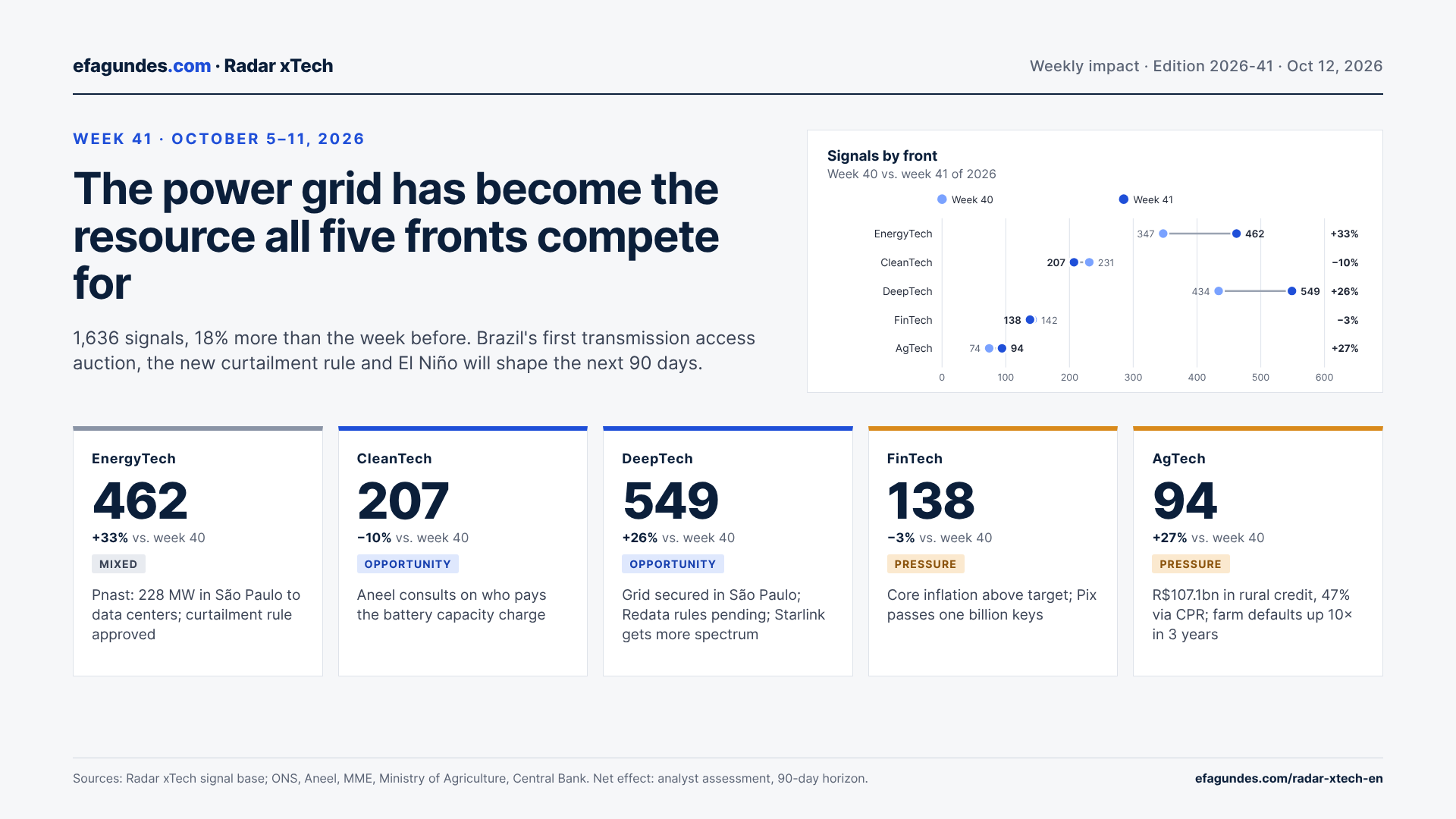
The week of October 5–11, 2026 brought 1,636 signals, 18% more than the week before. Brazil’s first transmission access auction, the new curtailment rule and El Niño will shape the next 90 days across the five xTech fronts.
Executive summary
- Grid capacity now has a price.Brazil’s grid operator (ONS) auctioned 228 MW in São Paulo to three data centers, against 451 MW of demand.1
- Money stays expensive.Core inflation broke above the target ceiling and farm loan defaults grew tenfold in three years; capital-intensive projects depend on contracted revenue.
- El Niño splits the fronts.It weighs on energy, agribusiness and data centers in the first quarter of 2027, but adds value to storage and biofuels.
By the numbers
Upcoming dates: Oct 30 transmission auction · Nov 6 battery consultation closes · Nov 22 Pnast consultation closes · Dec 2 and 4 battery auctions.
What changed in week 41 for tech and energy companies in Brazil?
Exhibit 1
EnergyTech and DeepTech drove the rise in signals, and AgTech grew on the eve of planting season
Signals collected by front, week 40 versus week 41 of 2026, number of signals
Note: the change on the right compares week 41 with week 40; cross-cutting signals are not shown. Source: Radar xTech signal base.
efagundes.comRadar xTech
Radar xTech, the intelligence system of the efagundes.com think tank, recorded 1,636 signals between October 5 and 11, 2026, up from 1,384 the week before. The increase was concentrated in three fronts and had a common thread: competition for infrastructure. Grid access was auctioned for the first time, satellite spectrum for mobile phones was expanded, and rural credit became more selective.
| Front | Week 40 | Week 41 | Change |
|---|---|---|---|
| EnergyTech | 347 | 462 | +33% |
| CleanTech | 231 | 207 | −10% |
| DeepTech | 434 | 549 | +26% |
| FinTech | 142 | 138 | −3% |
| AgTech | 74 | 94 | +27% |
| Cross-cutting | 156 | 186 | +19% |
| Total | 1,384 | 1,636 | +18% |
Counts by front reflect the coverage of monitored sources and do not, on their own, measure the importance of each event. The analysis therefore combines signal volume with an assessment of each event’s impact on companies in each front, over a 90-day horizon.
Which events of the week matter most for each xTech front?
Exhibit 2
El Niño and inflation weigh on almost every front; the grid and storage open opportunities
Direction of each event’s impact on companies in each front, Radar xTech assessment
Note: qualitative analyst assessment, 0 to 90-day horizon. Source: Radar xTech.
efagundes.comRadar xTech
The darkest row in the matrix is Pnast, Brazil’s National Transmission System Access Policy: a strong opportunity for DeepTech, because data centers secured grid capacity, and pressure on CleanTech, because renewable generators now compete for the same connection points against the highest bidders. Two rows weigh on all or almost all fronts: inflation above target, which delays rate cuts, and a very strong El Niño, which raises power price risk for the first quarter of 2027 and weather risk for planting. For CleanTech, the same El Niño is an opportunity, because it adds value to storage and biofuels.
How do this week’s events affect EnergyTech?
EnergyTech · 462 signals · +33% vs. previous week
The event of the week was Pnast’s first competitive round. The National Electric System Operator (ONS) allocated 228 MW of high-voltage transmission capacity at four connection points in São Paulo; 451 MW had qualified, and bids averaged about R$800 per kW1. The National Electric Energy Agency (Aneel) opened public consultation 36/2026, through November 22, to adjust access rules and add safeguards against capacity hoarding2.
After seven years of debate, Aneel approved the rule that sets the order of mandatory generation cuts (curtailment). Spilled hydro energy is phased in at 25%, 50%, 75% and 100% over four years; a 12-month shadow period starts 180 days after publication, and final application comes 18 months after publication3. The Ministry of Mines and Energy published the list of plants eligible for curtailment compensation4.
In natural gas, the Ministry of Development, Industry and Trade (MDIC) proposed that volumes from the gas release program go first to free-market consumers in basic industry5. The power sector monitoring committee (CMSE) reported reservoirs at 61% at the end of September, 5 points above 2025, but expects a very strong El Niño and use of the operating power reserve from January 20276.
What changes in 90 days: for traders and free-market consumers, first-quarter 2027 risk is already priced into contracts; anyone with uncontracted volume for the summer needs to decide before December. For energy services firms, Pnast creates demand for technical access studies, bidding strategy and management of contracted transmission capacity.
How do this week’s events affect CleanTech?
CleanTech · 207 signals · −10% vs. previous week
Aneel opened public consultation 37/2026, from October 8 to November 6, on how to fund the capacity reserve charge for battery storage. The draft would allocate the cost among generators registered with the wholesale market chamber (CCEE), excluding distributed micro and mini generation and standalone storage7. If it prevails, the charge falls on generators rather than end consumers.
You.On Energia and China’s HyperStrong signed a binding agreement to bid in the battery auctions of December 2 and 48. The local-content auction has priority in meeting demand and requires certification by development bank BNDES. Bidders without an accredited supplier are left with the open auction, facing more competition from imported equipment.
In biomethane, gas distributor Gasmig opened a new public purchase call9 and a R$150.4 million plant obtained the Reidi tax incentive10. With diesel up as the war in Iran resumed and sugar at a 19-month high, biofuels become more competitive.
How do this week’s events affect DeepTech?
DeepTech · 549 signals · +26% vs. previous week
Data centers locked in grid capacity in São Paulo: CloudHQ, for its Paulínia campus, and Digital DC Brasil took the 228 MW of Pnast’s first round1. Data center load on the high-voltage grid is set to triple in 2027, from 315 to 942 average MW, and reach 5,653 average MW in 203016. The sector’s bottleneck is no longer only tax but grid.
Brazil’s special tax regime for data centers (Redata) still awaits regulations, which the government expects by year-end; São Paulo state will wait for them before revising its ICMS tax, and companies are asking for a 90% cut in ICMS on equipment. Industrial development agency ABDI will map where to build new data centers in the country.
In telecom, regulator Anatel released 15+15 MHz in the S band so Starlink can offer direct-to-phone connectivity. On October 9, the prospect of the company entering mobile service sent Vivo (−5.25%) and TIM (−4.18%) lower on the B3 exchange11. Brazil accounts for 38% of the economic impact of cloud and AI in Latin America12.
How do this week’s events affect FinTech?
FinTech · 138 signals · −3% vs. previous week
September’s core IPCA inflation broke above the upper limit of the target, and the central bank’s Focus survey projects inflation above 5% for 2026. With sticky inflation, rate cuts are pushed back, and capital-intensive projects on all five fronts still depend on contracted revenue or subsidized credit. Even so, the Ibovespa closed at a record 209,067 points on October 9.
Pix, Brazil’s instant payment system, passed 1.008 billion registered keys on September 30 and processed 7.1 billion transactions in September, about R$3.2 trillion13. The central bank shortened the update cycle of its Credit Information System (SCR), which favors lenders that originate collateralized, data-rich credit.
How do this week’s events affect AgTech?
AgTech · 94 signals · +27% vs. previous week
Rural credit to commercial agriculture totaled R$107.1 billion from July to September 2026; rural product notes (CPR) accounted for R$50.3 billion, 46.9% of the total14. At the same time, farm loan defaults have grown tenfold in three years, and fertilizer deliveries fell 8.8% from January to July. Credit becomes more selective, and technologies that pay back within one harvest are more likely to be bought than heavy machinery.
Embrapa, the federal agricultural research agency, published El Niño risks for each region with recommendations for farmers. With the CMSE expecting a very strong El Niño between spring and summer, insurance, weather monitoring and irrigation move up the list. In connectivity, Vivo and Cerradinho Bioenergia will bring 4G to up to 1.4 million hectares15.
What should we watch through December?
| Date | Event | Fronts |
|---|---|---|
| Oct 25 | Presidential runoff election | All |
| Oct 30 | Transmission auction no. 04/2026, about R$8.88 billion | EnergyTech, FinTech |
| Nov 6 | Public consultation 37/2026 (battery charge) closes | CleanTech, EnergyTech |
| Nov 22 | Public consultation 36/2026 (Pnast access) closes | EnergyTech, DeepTech |
| Dec 2 and 4 | Battery-only capacity reserve auctions | CleanTech, FinTech |
| Dec 4 | ONS bidding methodology for 2027 | EnergyTech, DeepTech |
| December | Redata regulations | DeepTech |
| Jan 4–18, 2027 | Registration for the 2027 access season | EnergyTech, DeepTech |
Frequently asked questions
What were the main tech and energy events in Brazil in week 41 of 2026?
The first transmission access auction under Pnast, won by data centers in São Paulo; Aneel’s new curtailment rule; the public consultation on the battery capacity charge; additional spectrum for Starlink; core inflation above target; and the CMSE’s warning of a very strong El Niño.
Which xTech front had the most signals in week 41?
DeepTech, with 549 signals, 26% more than the week before. EnergyTech had 462 (+33%), CleanTech 207 (−10%), FinTech 138 (−3%) and AgTech 94 (+27%).
What is Pnast?
It is Brazil’s National Transmission System Access Policy, created by Decree 12,772/2025. It replaces the first-come, first-served queue with access seasons coordinated by the grid operator (ONS) and, where capacity falls short, with a competitive process in which bidders offer a premium in reais per kW.
What does Aneel’s new curtailment rule change?
It sets the order of mandatory generation cuts and gradually brings in spilled hydro energy at 25%, 50%, 75% and 100% over four years. A 12-month shadow period starts 180 days after publication; final application comes 18 months after publication.
Who will pay the battery capacity charge in Brazil?
Under the draft in Aneel’s public consultation 37/2026, open from October 8 to November 6, the cost would be allocated among generators registered with the CCEE, excluding distributed micro and mini generation and standalone storage.
When are Brazil’s battery auctions?
On December 2 and 4, 2026. The first is reserved for projects with local content and has priority in meeting demand; supply starts on August 1, 2028.
How this content is produced: Radar xTech’s daily collection gathers official sources, trade press and market data, classified by front. Analysis, exhibits and assessments are prepared with AI support and checked one by one against the sources; every figure cites its origin. The final edition is reviewed and signed by Eduardo Mayer Fagundes.
Sources
Original headlines in Portuguese.
- Data centers levam 228 MW na primeira disputa por acesso à rede de transmissão eixos · 7/10/2026
- ANEEL abre consulta para adequar regras de transmissão à PNAST Cenário Energia · 6/10/2026
- ANEEL aprova regra para organizar cortes de geração Aneel · 6/10/2026
- MME avança na compensação por cortes de geração com divulgação de lista de elegibilidade MME · 7/10/2026
- MDIC propõe prioridade à indústria no gas release; Abrace quer incluir Braskem MegaWhat · 8/10/2026
- Ações do CMSE garantem encerramento do período seco com reservatórios em níveis superiores aos do ano passado MME · 7/10/2026
- Custeio de sistemas de armazenamento de energia em baterias entra em consulta Aneel · 7/10/2026
- You.On e chinesa HyperStrong fecham parceria para leilões de baterias MegaWhat · 8/10/2026
- Gasmig abre mais uma chamada pública para compra de biometano MegaWhat · 11/10/2026
- Usina de biometano com investimento de R$ 150,4 milhões recebe incentivo do Reidi MegaWhat · 11/10/2026
- Possível entrada da Starlink no mercado móvel derruba teles nas bolsas Teletime · 9/10/2026
- Brasil concentra 38% do impacto econômico de nuvem e IA na América Latina Teletime · 9/10/2026
- Pix ultrapassa 1 bilhão de chaves cadastradas no Brasil Agência Brasil · 9/10/2026
- Crédito rural para a agricultura empresarial soma R$ 107,1 bilhões nos três primeiros meses da safra 2026/2027 MAPA · 9/10/2026
- Vivo e Cerradinho Bioenergia vão conectar até 1,4 milhão de hectares Teletime · 8/10/2026
- Projeção de carga de data centers na Rede Básica sobe 63,5% e pode chegar a 5.653 MW médios em 2030 DCD · 8/10/2026